Best | Animal Xxx Videos

As consumers of popular media, the power rests with the audience. By practicing digital media literacy—learning to recognize signs of animal stress, refusing to engage with exotic pet trends, and reporting staged rescue operations—viewers can reshape the algorithm. Turning animal media into a force for genuine welfare ensures that our digital obsession protects, rather than harms, the creatures we love to watch.

Programs like Planet Earth and Blue Planet , narrated by Sir David Attenborough, combine cinematic technology with urgent environmental messaging.

Since the dawn of storytelling, animals have captivated human imagination. From ancient cave paintings depicting hunting scenes to today's TikTok videos featuring dancing dogs, the relationship between animal entertainment content and popular media represents one of the most enduring and evolving partnerships in human culture. We simply cannot get enough of our furry, feathered, and scaled counterparts on screen.

October 26, 2023 Subject: Analysis of the Evolution, Economics, Ethics, and Future of Animal-Based Entertainment animal xxx videos best

| Format | Examples | Key Trait | |--------|----------|-----------| | | @jiffpom (dog), @nala_cat (cat) on TikTok/Reels | Highly edited, sound-synced, “talking” pets via voiceover | | Reality/Nature Documentaries | Planet Earth , My Cat from Hell , The Zoo | High production value, often with conservation messaging | | Livestreams | Kitten rescue cams, aquarium live feeds, bird nest cams | Unedited, ambient, therapeutic background content | | Animated/Fictional Animals | Zootopia , Paw Patrol , The Lion King | Anthropomorphic narratives that teach social lessons | | User-Generated “Fails” | America’s Funniest Home Videos , Reddit’s r/AnimalsBeingDerps | Low-stakes, relatable, humor-driven |

Major streamers (Netflix, Disney+, HBO) now have strict animal welfare clauses in their production contracts. Live exotic animal acts are increasingly rare in A-list cinema.

The mid-20th century shifted real animals to anthropomorphic animations. Walt Disney Studios revolutionized the industry by giving human traits, emotions, and speech to animal characters. As consumers of popular media, the power rests

will likely increase. Future audiences may demand documented evidence of ethical production practices as a condition of engagement. Several production companies already publish "welfare impact statements" alongside their animal content, a practice that could become standard.

Social media has created a new class of celebrity: the "pet influencer." Channels dedicated to slow lorises holding tiny umbrellas, poodles walking on hind legs, or hedgehogs eating miniature tacos dominate our feeds.

operates with virtually no oversight. Viral challenges have encouraged dangerous behaviors, from forcing pets into stressful situations for reactions to capturing wild animals for thumbnails. The "sad animal video" genre, which rescues animals from manufactured peril, has been exposed as staged cruelty in numerous cases. Platforms have begun implementing policies against animal harm content, but enforcement remains inconsistent. Programs like Planet Earth and Blue Planet ,

already produces convincing animal images and videos. As the technology improves, entirely synthetic animal content will become indistinguishable from real footage. This raises profound questions: Does synthetic animal content reduce harm by eliminating live animal use? Or does it further disconnect audiences from the reality of animal welfare issues?

Advanced AI and real-time rendering will completely replace live exotic animals in commercial media, eliminating onset welfare concerns.

Media popularity often drives problematic consumer trends. The popularity of owls in Harry Potter or clownfish in Finding Nemo led to spikes in the poaching and unsustainable purchasing of those species. 4. Educational Media and Conservation

The most successful animal entertainment content of the future will likely be that which most honestly portrays animals as they truly are—not as furry humans, not as savage beasts, not as props for our emotional needs, but as fellow beings with their own lives, needs, and intrinsic worth. When popular media achieves this balance, it doesn't just entertain us. It expands our capacity for empathy across the boundaries of species.
animal xxx videos best

Avisoft-SASLab Pro is compatible:

  • Supports all common soundcards and USB audio interfaces

  • Opens .wav and .bwf files that have been recorded by any solid state / hard disk field recorder

  • Imports soundfiles that have been recorded with third-party sound recording/processing tools (.WAV .BWF .AIF, .SND, .AU, various binary formats and .txt)

  • Exports images and measurement results as files (.wmf, .bmp, .tif, .txt, .htm, .xml, .sql), via clipboard or through DDE directly into Excel

  • Exports georeferenced field survey data by means of .txt, .kml, .gpx or .shp files into GIS applications (including Google Maps / Google Earth, ArcGIS products, Quantum GIS and many others)

  • The software can be configured for touch screen operation in order to facilitate its use on tablet PC's.

Avisoft-SASLab Pro is comprehensive:

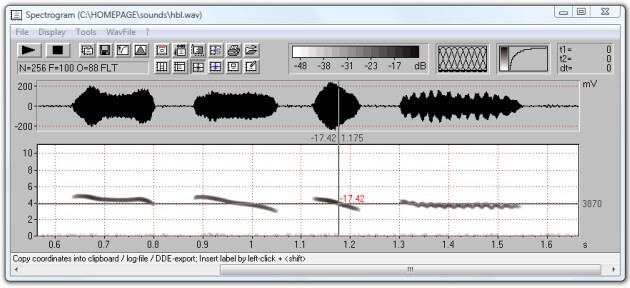
  • Color-coded spectrograms (FFT size of 64 to 1024 points), high quality spectrogram output with TrueType fonts

  • Real-time spectrogram display with circular buffer recording

  • Digital filtering for removing noise

  • Flexible cursors for measuring spectrogram structures

  • Versatile automated sound parameter measurement and classification facilities (event detection, analysis, classification and statistics)

  • Labeling option for single point and time section labels

  • Magnitude- and Powerspectrum, Linear Predictive Coding (LPC), Auto- and Crosscorrelation, Cepstrum, Histogram, 2D and 3D Scatterplot, 3D Waterfall display, Impuls-Density-Histogram, Envelope and Instantaneous frequency using hilbert transformation, frequency shift using FFT technique, Root mean square, Sound similarity matrix for comparison of spectrograms

  • Octave and Third-Octave Analysis for noise level measurements

  • Heterodyned payback of (full-spectrum) ultrasound recordings

  • Synthesizer for generating artificial songs and calls by mouse drawing of the parameter evolution (fundamental frequency, envelope, harmonics, frequency and amplitude modulation). Listen to a few synthesized bird songs

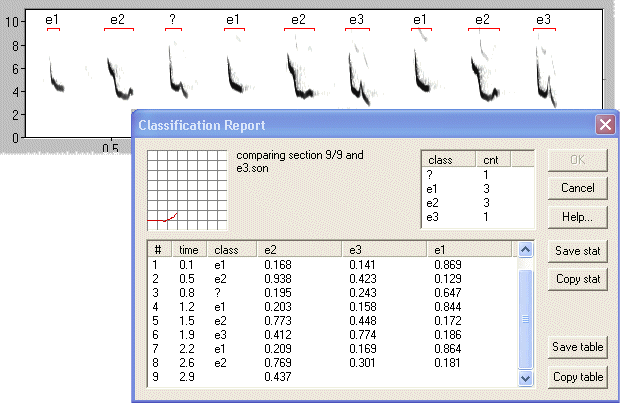
  • Automated classification of syllables by means of spectrogram cross-correlation with templates

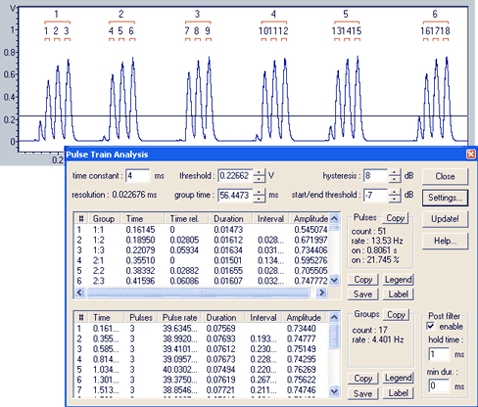
  • A dedicated pulse train analysis tool supports the investigation of temporal patterns of both simple pulse trains or series of sound bursts (e.g. song elements)

  • Georeferencing (also referred to as geocoding, geolocating or geotagging) .wav files that have been recorded with a digital field recorder by using GPS track log data (see the Bird Species Map and SONY PCM-M10 samples)

  • Creating field survey maps from labeled or renamed (with filenames containing species prefixes) .wav files that can be easily imported into GIS applications, including Google Maps or Google Earth (see the Avisoft Bat Survey sample).

  • Synchronizing audio and video recordings by using SMPTE or LANC timecode information (both reading and writing)

  • Advanced metadata management capabilities including user-defined database fields that can be collected into a virtual (XML-formatted) metadatabase, which can subsequently be queried within the Avisoft-SASLab Pro software.

  • Batch and real-time processing for managing large numbers of sound files.

  • and much more ...

System Requirements

Avisoft-SASLab Pro is compatible with any PC running Windows 11, 10, 8.1, 8, 7 or Vista including Intel-based Apple Macintosh running Boot Camp, Parallels or similar virtualization software.

Analysis procedures can be accerated by using a SSD rather than a conventional HDD for the Windows Documents folder.

  • Peter K. McGregor, Nottingham University and Jo Holland, University of Copenhagen: Review in Animal Behaviour
    1995, Vol 50, No 10

    The combination of these features means that the software pretty much lives up to the claims made in the advertising flyer that it is easy and intuitive to use.” … “Avisoft provides cheap, powerful sound analysis for PC’s.” … “If you already have an IBM-compatible computer of the appropriate specification, then Avisoft is a most attractive package

  • Richard Ranft, National Sound Archive London: Review in Bioacoustics
    1995, Vol. 6, No 3

    I find Avisoft is a joy to use. The facility and speed with which the user can assess long recordings using the real-time display, prepare and print sonograms and other spectra quickly or export them to other Windows applications, while in full control of the analysis and display parameters, makes this an invaluable programme for bioacoustic research and education.

  • Jon Russ: Review in the newsletter of the UK National Bat Monitoring Programme, Bat Monitoring Post
    December 2002

    I’ve been looking for a number of years for a software package that allows the user to simply rub out superfluous portions of the sonogram and with SASLab Pro I have finally found one.

Screen shots

Automatically measuring sound parameters on the spectrogram:

  • animal xxx videos best
  • animal xxx videos best

Syllable classification by means of spectrogram cross-correlation:

  • animal xxx videos best
  • animal xxx videos best
For more details on the SASLab Pro software see the tutorials, the revision history or download the free Demo/Lite version with its HTML formatted online help system.

Who uses Avisoft-SASLab Pro?

Avisoft-SASLab Pro is being used by thousands of users for investigating acoustic communication in various animal species including birds, mammals, rodents, frogs, fish and insects. See papers on Google Scholar reporting the use of the Avisoft-SASLab Pro software.

As consumers of popular media, the power rests with the audience. By practicing digital media literacy—learning to recognize signs of animal stress, refusing to engage with exotic pet trends, and reporting staged rescue operations—viewers can reshape the algorithm. Turning animal media into a force for genuine welfare ensures that our digital obsession protects, rather than harms, the creatures we love to watch.

Programs like Planet Earth and Blue Planet , narrated by Sir David Attenborough, combine cinematic technology with urgent environmental messaging.

Since the dawn of storytelling, animals have captivated human imagination. From ancient cave paintings depicting hunting scenes to today's TikTok videos featuring dancing dogs, the relationship between animal entertainment content and popular media represents one of the most enduring and evolving partnerships in human culture. We simply cannot get enough of our furry, feathered, and scaled counterparts on screen.

October 26, 2023 Subject: Analysis of the Evolution, Economics, Ethics, and Future of Animal-Based Entertainment

| Format | Examples | Key Trait | |--------|----------|-----------| | | @jiffpom (dog), @nala_cat (cat) on TikTok/Reels | Highly edited, sound-synced, “talking” pets via voiceover | | Reality/Nature Documentaries | Planet Earth , My Cat from Hell , The Zoo | High production value, often with conservation messaging | | Livestreams | Kitten rescue cams, aquarium live feeds, bird nest cams | Unedited, ambient, therapeutic background content | | Animated/Fictional Animals | Zootopia , Paw Patrol , The Lion King | Anthropomorphic narratives that teach social lessons | | User-Generated “Fails” | America’s Funniest Home Videos , Reddit’s r/AnimalsBeingDerps | Low-stakes, relatable, humor-driven |

Major streamers (Netflix, Disney+, HBO) now have strict animal welfare clauses in their production contracts. Live exotic animal acts are increasingly rare in A-list cinema.

The mid-20th century shifted real animals to anthropomorphic animations. Walt Disney Studios revolutionized the industry by giving human traits, emotions, and speech to animal characters.

will likely increase. Future audiences may demand documented evidence of ethical production practices as a condition of engagement. Several production companies already publish "welfare impact statements" alongside their animal content, a practice that could become standard.

Social media has created a new class of celebrity: the "pet influencer." Channels dedicated to slow lorises holding tiny umbrellas, poodles walking on hind legs, or hedgehogs eating miniature tacos dominate our feeds.

operates with virtually no oversight. Viral challenges have encouraged dangerous behaviors, from forcing pets into stressful situations for reactions to capturing wild animals for thumbnails. The "sad animal video" genre, which rescues animals from manufactured peril, has been exposed as staged cruelty in numerous cases. Platforms have begun implementing policies against animal harm content, but enforcement remains inconsistent.

already produces convincing animal images and videos. As the technology improves, entirely synthetic animal content will become indistinguishable from real footage. This raises profound questions: Does synthetic animal content reduce harm by eliminating live animal use? Or does it further disconnect audiences from the reality of animal welfare issues?

Advanced AI and real-time rendering will completely replace live exotic animals in commercial media, eliminating onset welfare concerns.

Media popularity often drives problematic consumer trends. The popularity of owls in Harry Potter or clownfish in Finding Nemo led to spikes in the poaching and unsustainable purchasing of those species. 4. Educational Media and Conservation

The most successful animal entertainment content of the future will likely be that which most honestly portrays animals as they truly are—not as furry humans, not as savage beasts, not as props for our emotional needs, but as fellow beings with their own lives, needs, and intrinsic worth. When popular media achieves this balance, it doesn't just entertain us. It expands our capacity for empathy across the boundaries of species.